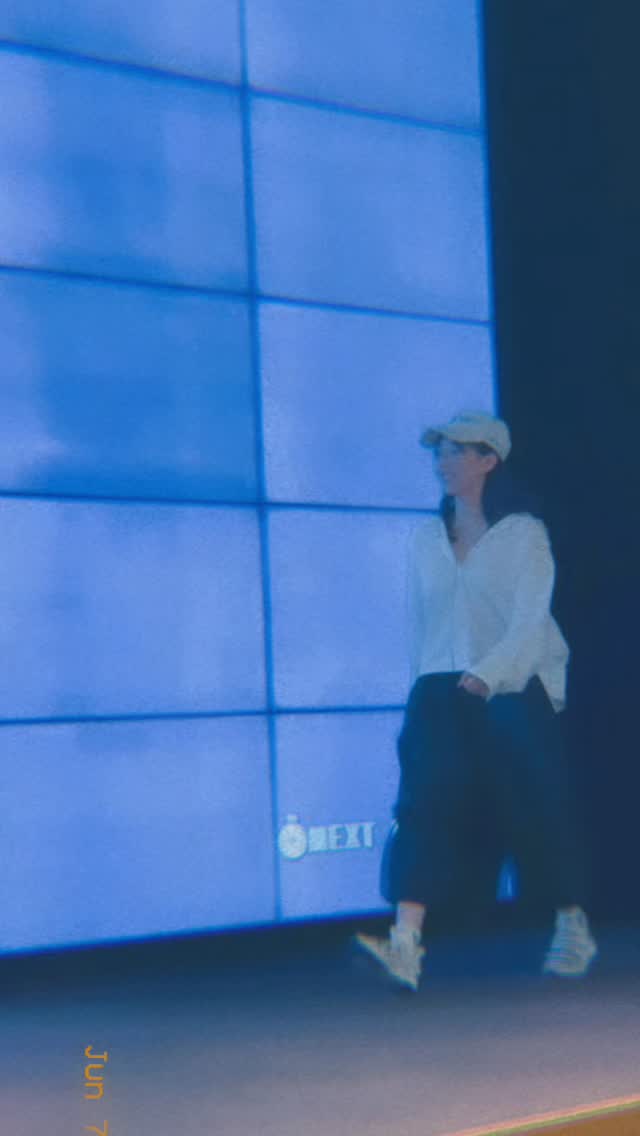
A TED talk given in Nagoya · June 6, 2026
A straight line is the shortest path between two points. School taught us to live on it. AI is the perfect creature of it. But humans don’t grow in lines — we grow in circles, rippling outward. Love sets us apart from machines and is the widest ripple of all.
Opening — The Improbability of the Moment
皆さん、こんにちは。はじめまして。私はNingshanです。ここに立ってスピーチできることを本当にワクワクしてます。ありがとうございます。これから英語かな、笑
First I’d like to take a moment to thank everything and everyone that has brought me here, to this moment.
Around us, so many things are happening at once. Stars colliding. Rockets being launched into space. Somewhere, a monkey is eating a banana. Animals are slowly evolving. Billions of decisions are made — and out of all of that, all that space, all that time that came before us — we ended up in the same room, and slice of time, breathing together.
My words are leaving my mouth as small packets of energy, traveling across this air, and landing inside your ears. And maybe — maybe — something I say will change something you do tomorrow. Or in ten years. Or maybe nothing at all.
But when we leave this room, it is almost certain we will never all be gathered like this again. I think that’s incredible.
So before anything else — thank you.
Part One — The Straight Line
So. How did a person like me end up in Japan, giving a speech?
Last year, I graduated from MIT after five years studying computer science and neuroscience. That was the first time in my life I had ever stepped outside of school — twenty years inside it, from kindergarten at three years old, all the way to a master’s at twenty-three.
And I have to tell you: the real world is nothing like school.
In school, the system is determined for you. There are fixed metrics for evaluation — grades, popularity. Everything is a straight line. We all know from math: the shortest distance between two points is a straight line. And somehow, we’re taught to live that way too.
If you want a good high school, get good grades in middle school. If you want a good college, get even better grades, be competitive, do the extracurriculars, write the essay that makes you sound extraordinary. Then in college, stack every title, internship, research and skill onto your résumé, so a company will pick you.
Point A. Point B. As fast as possible. A straight line.
Until high school, I was very good at that line. I studied and stayed up until five, six in the morning. So when I finally graduated and stepped out into the real world, everyone assumed I’d do the most optimal thing imaginable. The timing was perfect — AI was exploding. Silicon Valley was right there. The obvious next point on the line.
Instead, I flew to Japan to learn rock music, specifically guitar and drums.
Part Two — Growing in Circles
My parents could not understand it. They kept saying: “This is the best possible moment to go work on AI. Why are you going to Japan to bang on drums at 23 with a degree in computer science?”
And my answer was almost embarrassingly simple. I just really wanted to learn rock. I didn’t care that I was twenty-three — which, for music, is laughably late to begin. I wasn’t trying to become a professional. It just felt important in a way I couldn’t justify on any résumé.
So I spent three months in Japan doing nothing but music — guitar, drums, singing, composition. And somewhere in those three months, I started to question the whole idea of the straight line.
Because if you think about it: we all begin at the exact same point A. We open our eyes, we’re blinded by the hospital lights, we move our little bodies — we are born.
And here’s the part most of us are too young to think about: we also all share the same point B. One day we’ll be old. Our bodies will stop listening to us. And eventually we’ll lie down somewhere, hand our consciousness back to the universe, and think — what a life that was.
Same point A. Same point B. For every single person in this room.
So if the start and the end are already identical — what exactly are we rushing toward? Why sprint down a straight line, when the line leads to the same place for all of us anyway?
That’s when I felt that life isn’t a race to optimize. Life is something we grow radially — outward, in every direction, like rings spreading on water, like ripples. And you grow those rings by making messy, “non-optimal” choices. Like flying to Japan to bang on a drum kit at 23.
The strange thing about the messy choices I have made is that they often led me to the right places and the right people.
In Japan I ended up farming in Hayama. I stood in a field, listened to the insects singing, and felt the soil that has fed the living — and I felt intensely alive. No loss optimizer or algorithm would ever have routed me there.
And that’s where I met Satoshi — the drummer for RADWIMPS — who gave me more courage and inspiration than almost anyone in my first year out in the world. Because of that, a few months later, I played my very first concert, in San Jose. I’d only picked up a guitar that summer — and five months later I was singing in front of sixty people.
Was it professional? No. Was it good? No — I cried my eyes out the night before. Yet I still sang. And that experience was uniquely mine.
None of that was on the straight line of optimizing for success. Every bit of it came from stepping off it.
Part Three — The Perfect Optimizer
There is something in our world right now that is the most perfect straight-line optimizer ever created. We call it artificial intelligence.
For a long time, I wasn’t impressed by it. Even in college, AI felt like glorified pattern-matching — you pour in a mountain of past data, and it predicts the next thing. It felt very far from being human.
But in just the past year, it has grown staggeringly good. It reads every token humanity has ever written and produces new ones — reasoning, writing, creating. And I’ll be honest with you: it frightens me sometimes.
When I watch AI generate something brilliant, faster than any human ever could, a small voice asks —
If the machine optimizes better than I ever will, what is left for me?
And that question — what is left for us humans? — will probably turn out to be the most important question of my generation.
AI can learn everything that humans have expressed. Every word, every pattern, every structure of thought ever written down. But there is something it cannot learn from text. The first is the simple feeling of being alive — the small specific happiness. For me, it is eating strawberries late at night. Biting into fruit. Jumping into the water, swimming with sharks, singing and feeling the emotions of each word.
There is something primitive about living that no dataset can hold.
And the second — the one I think matters most — is love.
Part Four — Love Is the Widest Ripple
AI can produce, optimize, and output things more extraordinary than anything I will ever make — but it cannot love what it does. It cannot lie awake at two in the morning unable to stop thinking about someone, or stand in front of sixty strangers and feel its own heart slam against its chest the way mine did in San Jose and is doing now.
What if we fed it everything — every love song, every letter, every breakup text, every wedding vow, every three-in-the-morning poem written for someone who never wrote back — could it finally learn to love?
I don’t think so.
It would only learn the average of love: the most likely word after “I love you,” the perfect gesture that tests well with the most people. It would perform love flawlessly — honestly, it could probably out-write me in a confession.
But love is the opposite of an average.
Love is the most specific thing in the universe — that person, that one song you’ve played four hundred times, that irrational thing you would burn the entire optimal path down for.
And maybe you’re thinking: fine — fine-tune the machine on one single person until it speaks a love that is perfectly, specifically yours. Even then, it would not be love, because we would have given it the output of love and missed the whole point.
Love was never the beautiful words. Love is what those words cost you — that you could be wrong, that you could be left, that to love someone is to hand them the power to break you and to do it anyway.
A machine can generate “I would die for you” a million times without flinching, because it has nothing at stake: no skin, no two a.m., no breaking heart. A love that risks nothing isn’t love. It’s just a very good sentence.
It would learn the shape of love. It would never feel the weight of it.
The feeling of love is, uniquely and irreducibly, a human privilege.
But I’ll admit — it’s hard for humans to learn what love is, too.
For me, love doesn’t just mean romantic love. It includes the feeling of being completely absorbed in — completely dedicated to — someone, or something. It includes the love I give my friends, my family, even strangers — people I have no connection to, except that we are both human.
I have been shaped by that love. Specifically, by people who supported me in being myself, instead of expecting me to be someone useful. People who let me experience the world without demanding I “output useful tokens.”
That love is the only reason I had the courage to fly across an ocean and learn the drums, to see the world, for no reason but joy.
I think love is what makes us human. It is the widest ripple we can ever set in motion.
Closing
To be honest — when I was asked to speak at this TED talk, I had no idea or confidence that I could say anything useful. I’m still just 24, and trying to be human for the first time.
But for those of you agonizing over which college, which major, which path to take — I want to gently offer a different question. Not “how do I get to the right place?” but:
“How do I grow the widest circle of myself? How do I become the most myself, simply by doing what I love?”
Some thinking of getting from A to B is important. We do need the Shinkansen — shortest path, Tokyo to Nagoya.
But it’s also okay to stop trying to be the fastest point on someone else’s line, unless you truly believe in it. And really try to feel being alive — it is the rarest privilege there is, and I think it’s the only thing worth optimizing for.
Give yourself permission to be messy. To make the wrong-looking choice. To be grateful for every accidental encounter — the field, the stranger, the detour — because those are the things that grow you outward into someone a straight line could never have reached.
And the biggest ripple you will ever make in another person’s life is simply learning to love: letting yourself be yourself, and letting others be themselves. That is the greatest love I have ever been given and can give. It’s the reason I’m standing here, trying to become the fullest version of myself I can be.
So jump in. Be the stone in the water. And let the ripple of love spread.
Thank you so much.